How to play Quad Chase
A round is twenty seconds long. Somebody is chasing you, or you are chasing somebody. That is the entire game, and everything below is detail on top of it.
PLAY NOWThe round
Quick play runs in rounds of 20 seconds. As the evader, outlast the clock and the round is yours. As the chaser, tag the runner before the clock dies — and the faster you do it, the bigger the bonus.
You carry four lives. A tag costs one, and the run ends when the last one goes. Between rounds nothing resets except the arena: the blocks move, the chaser changes, and the round number keeps climbing. There is no final round. The run ends when you are caught for the fourth time, so your score is really a measure of how long you kept your composure.
Scoring rewards nerve rather than caution. Surviving a round pays, but so does a near miss — passing close enough to a lunge to feel it earns a bonus and briefly slows time, which is the game telling you that you did the right thing. Running laps of an empty corner is safe and pays almost nothing. A combo multiplier builds across clean rounds and breaks when you are tagged.
Controls
Phone or tablet
- Move — drag anywhere on the screen. A stick appears under your thumb and follows it, so you never have to find a fixed pad in the dark.
- Dash (evader) or lunge (chaser) — three ways, all equivalent: the corner button, a second finger anywhere on screen, or a quick double-tap of the stick.
- The action button glows when the charge is back. A thin ring around your disc drains and refills with it.
Keyboard
- Move — arrow keys or
WASD. - Dash / lunge —
Space. - Pause —
PorEsc. Mute —M. - On the game-over screen,
Spaceretries.
The dash is not a speed boost you hold down — it is a single hard burst on a cooldown, and its real value is that you are briefly untouchable in ways the chaser cannot answer. Spending it the moment you feel nervous is the most common way to die at round 10.
Orbs
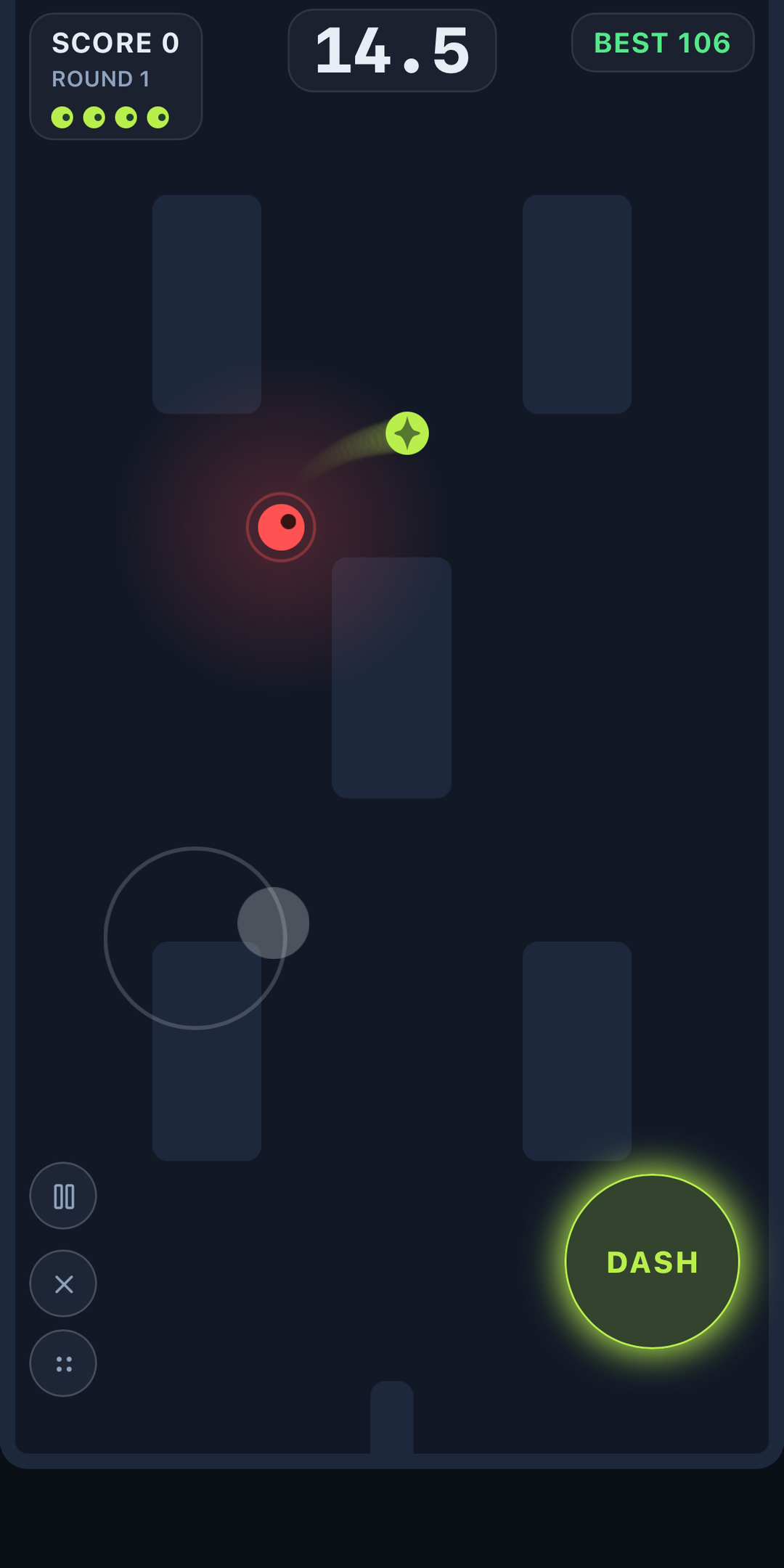
Orbs drift into the arena mid-round and either side can take them. What an orb does depends on which role you are playing, which means a contested orb is a genuine decision rather than a pickup.
| Orb | As evader | As chaser |
|---|---|---|
| SPEED | +25% speed for 3 seconds | +22% speed — either side can steal it |
| FREEZE | chasers crawl for 2 seconds | the evader crawls for 2 seconds |
| POINTS | +25 points, multiplied by your combo and any doubler | |
| LIFE | restores a heart — only spawns when you are already hurt | |
| SHIELD / OVERTIME | blocks one tag, kept until it is used | +4 seconds on the clock |
| SCORE ×2 | every point doubled for the rest of the round | |
The shield is the one worth going out of your way for, because it is the only thing in quick play that undoes a mistake. It also explains why a chaser should contest it: in chaser hands the same orb becomes four more seconds of hunting.
Skills unlock as you go
You do not choose a loadout in quick play. Skills arrive on a schedule, one every few rounds, so the game teaches itself in the order the rounds get harder. Both roles get six, and they mirror each other.
| Round | Evader | Chaser |
|---|---|---|
| 3 | VAULT — dash into a block to leap clean over it, untouchable mid-air | LONG LUNGE — your lunge carries 40% further |
| 8 | SECOND DASH — two charges, each with its own ring | SECOND LUNGE — herd with one, strike with the other |
| 12 | PERFECT DODGE — dodge a lunge while dashing for triple points and an instant refund | PERFECT POUNCE — miss by a hair and the lunge refunds instantly |
| 16 | DECOY — dashing leaves a ghost behind; chasers hunt the ghost | SNARE — lunges drop a lure the evader drifts toward, then it snaps shut |
| 20 | WALL KICK — dash into a wall and kick off along it, steered where you point | LEAPFROG — lunges sail over blocks, swelling like a jump |
| 24 | AFTERBURN — your trail lingers and slows anything that crosses it | PRESSURE — stay close and a ring fills around the evader; full means it tires |
Perks are separate. You unlock them by playing and equip one at a time from the ✦ button on the menu — small, permanent tweaks to how your disc handles, rather than new moves.
Who is chasing you
There are four chaser personalities and they are not difficulty tiers — they are different problems. The game names the one you are facing before the round starts, and a hint under the name tells you its weakness.
THE RUNNER
Keeps pace with you and never falls behind. It is the honest one: watch the lunge, because that is the only moment it commits.
THE LUNGER
Slow feet, long lunges, and it fires them often. You can out-walk it; you cannot out-wait it.
THE STALKER
The fastest of the four and it never lunges at all. It simply arrives. Clumsy up close, so sidestep rather than sprint.
THE AMBUSHER
Weak legs and a lunge that crosses half the arena. Distance is not safety from this one.
Chasers do not run at where you are — they intercept where you are about to be. From round 8 most rounds send a second chaser, and the pair flank rather than follow; every third round stays a lone chase so the rhythm never flattens. From round 14 they can turn up ELITE, marked with a gold ring: an elite feints its lunges and shakes a decoy off early instead of falling for the whole thing.
Playing as chaser, the mirror applies. The runners you hunt have their own personalities, they get wilier at round 14, and from round 18 most rounds send out two. Catching one pays points and puts 5 seconds back on the clock. Only a clean double escape costs a life — but letting one go costs your combo, and one clean round wins it back.
Round 25 and the wildcards
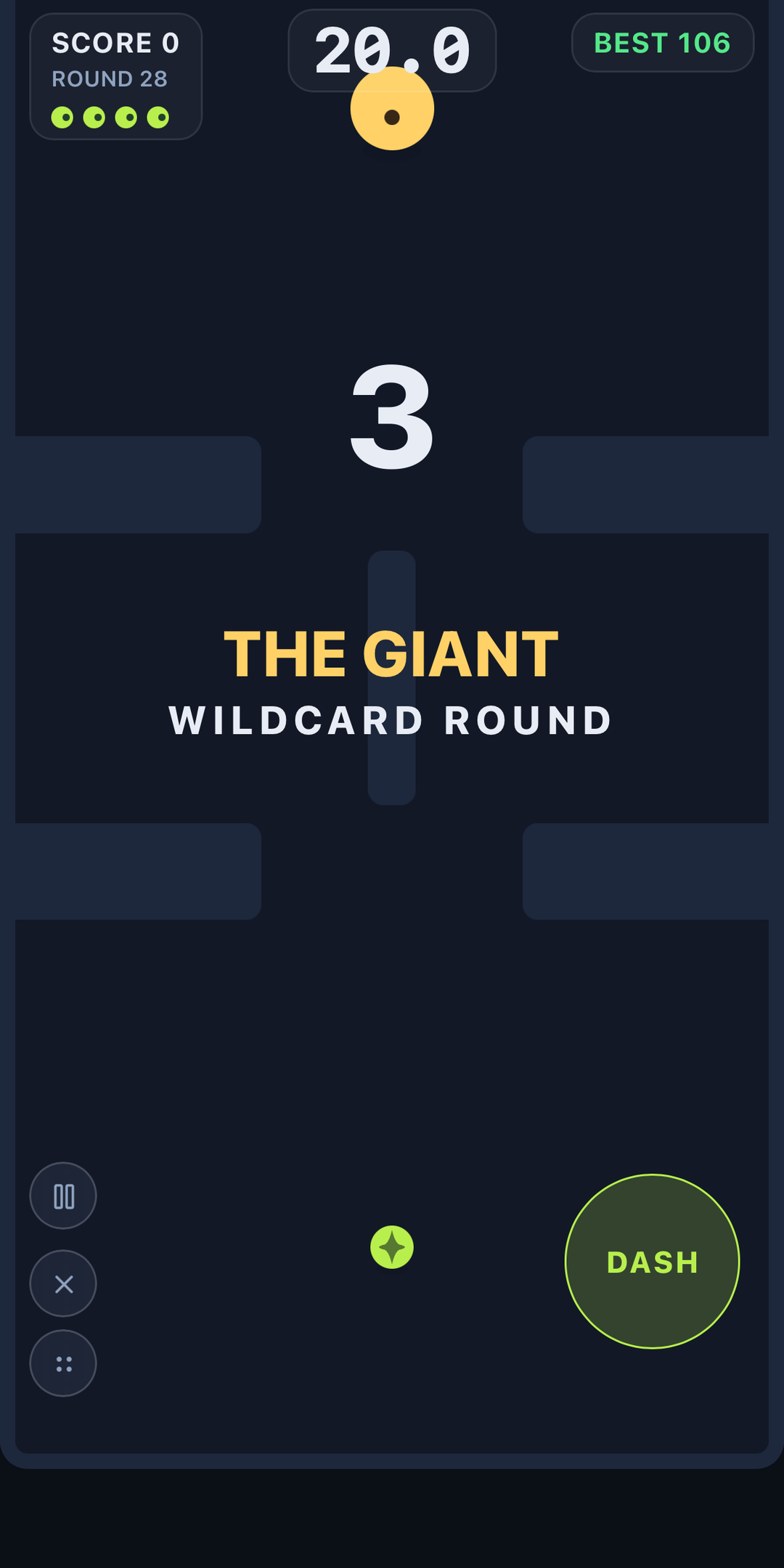
From round 25, every third round breaks a rule and announces itself with a gold banner. The same twist never runs twice in a row.
| Wildcard | What changes |
|---|---|
| ORB RUSH | Orbs rain down — they respawn about three times as fast. |
| GOLD RUSH | Orbs rain coins for your disc, with the odd SCORE ×2. |
| THE SWARM | Three chasers at once, all noticeably slowed. |
| THE GIANT | One huge, relentless chaser, a little slower than usual. |
| CLOSE QUARTERS | The arena starts already squeezed in tight. |
| BLACKOUT STORM | Lights out and the walls closing, at the same time. |
| FRENZY | Everyone — you included — moves about 12% faster. |
| MARATHON | A 30-second round instead of 20. Surviving pays double. |
Quick play is only the front door. Every run you finish pays coins to a disc of your own, which you train and take down into the arena — a one-life descent with bosses, bought skills and a leaderboard for how deep you got.