The Arena
Quick play is twenty seconds at a time. The Arena is the part you come back for: one disc that you raise, equip and take down an endless descent where a single tag ends the run.
OPEN THE ARENAYour disc
You start by making one. Pick a colour, give it a name, and it is yours — kept in this browser, not on an account. Everything the Arena does afterwards happens to that one disc.
A disc has four stats, and they are read directly by the game rather than being a display of a hidden number:
| Stat | What it actually does |
|---|---|
| SPEED | Top speed. A small edge, always on. |
| STAMINA | Dash and lunge both come back faster. |
| AGILITY | Dash and lunge length — how far one carries you. |
| NERVE | Composure. A chaser commits later against you, and reads you slower. |
POWER, and why you cannot have all of it
Stat points come out of one shared pool. The pool is called POWER and the size of it is MAX POWER. Raising SPEED is choosing not to raise NERVE, which is what makes a disc a shape instead of a score. Two players at the same MAX POWER can have completely different discs, and against a given boss one of them is wrong.
Your rank sets the starting size of that pool and the ceiling on any single stat. Promotion is automatic the moment the bar fills — there is no separate counter to grind.
| Rank | Per-stat cap | Base MAX POWER |
|---|---|---|
| ROOKIE | 35 | 60 |
| PRO | 60 | 110 |
| ELITE | 80 | 170 |
| CHAMPION | none | 230 |
A CHAMPION has no per-stat limit at all, so a stat can climb past 100 indefinitely. It does not break the game because the effects saturate: the benefit of a stat keeps growing but flattens as it climbs, approaching double and never passing it. 300 beats 100 and 900 beats 300 — just never by as much as the numbers suggest. Without that rule, enough NERVE would reduce a boss's lunge to nothing.
Two currencies, and only one of them makes you bigger
This is the central idea of the Arena, and it is worth being blunt about because it is what stops the mode from being a grind.
COINS — earned anywhere, buy points and skills
Every run pays coins, including ordinary quick play. Coins buy stat points and skills. A point costs more at every rank. Coins can only ever make your disc fuller.
DEPTH — earned only in the descent, buys the room to hold points
+8 MAX POWER for every descent floor past floor 5, and +20 for every boss you put down. Permanent, uncapped, and unbuyable. This is the only thing that makes your disc bigger.
Grind quick play forever and you end up with a completely full disc and coins you cannot spend. That is not a bug — it is the answer to "what is the descent for". If you want a stronger disc, you have to go down.
Skills
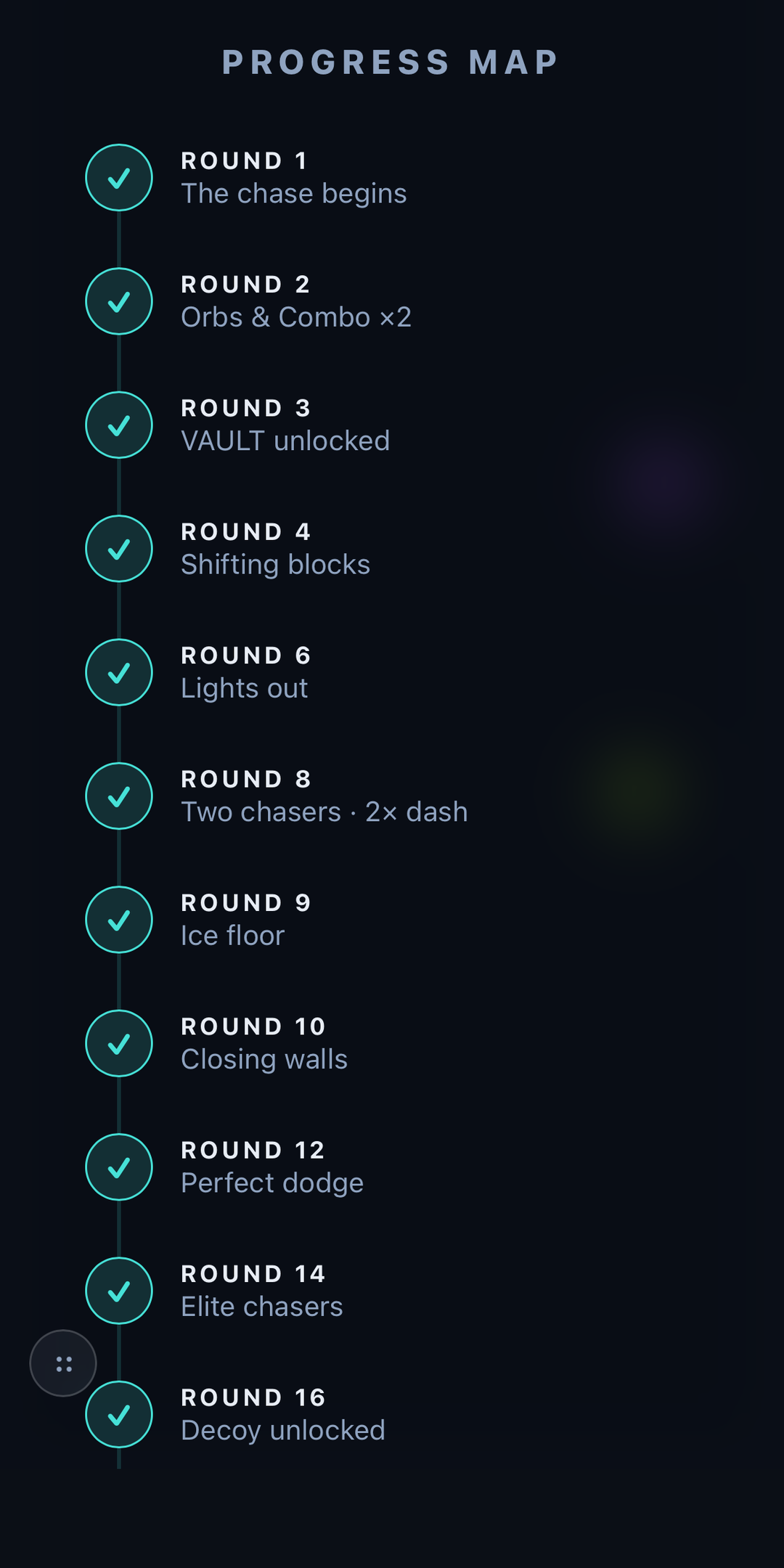
Quick play hands out its six moves on a round schedule — VAULT, SECOND DASH, PERFECT DODGE, DECOY, WALL KICK and AFTERBURN at rounds 3, 8, 12, 16, 20 and 24 — as a tutorial, one new idea at a time.
The Arena has no schedule, because its floors are the pressure. Down here you buy the same six in the den with the same coins that buy stats, and a bought skill is yours from floor 1, for good. It means what your disc can do is something you chose rather than something the round number gave you. Quick play is unchanged.
Drops
The four bosses each hand over a drop the first time you beat them. Drops do not exist in quick play at all, and you carry one at a time — tap a chip in the den to swap, tap it again to carry nothing.
MATADOR — THE GALE
Evading, a lunge that misses you closely overshoots; into a wall, and it is stunned. Chasing, your button feints — selling a lunge that never comes.
PULSE — THE ANVIL
Evading, a chaser almost on you is shoved clear, its wind-up wiped and its lunge gone for a beat. It breaks contact rather than buying you ground. Chasing, launching a lunge kills their dash mid-flight: they spend the charge, go nowhere, and the lunge arrives at a disc that has stopped.
SWAP — THE ORACLE
Trade places with the nearest disc if it is close enough. Running, you come out behind whatever was chasing you; hunting, you take the ground it was about to use. You turn with the swap either way, so the move that saved you does not walk you straight back in.
SMOKE — THE VEIL
Vanish. Drop a cloud and your disc leaves every screen for a few seconds — on yours it thins to an outline, enough to steer by — while a chaser that has lost you commits to where you were. The cloud stays behind, marking a place you are not.
Three of the four fire off your dash, so the button you already use is also your answer. Each waits a few seconds before it will fire again, which is why a second dash charge is a second dash and not a second escape.
Pick before you dive. Once a descent is under way the chips lock, and walking away mid-run does not reopen them. A checkpoint does: put a boss down and the stretch after it is a fresh attempt, so it gets a fresh choice.
The descent
Endless floors. One life. No heart orb spawns down here and no boost hands one out.
Clear a floor and you are offered three boosts and keep the one you pick for that floor only. That is deliberate: a pile of permanent boosts would make floor 20 easier than floor 5, which is exactly backwards. Instead every draft is a fresh read of what is in front of you, and the boost you are carrying is named under your disc while you play.
Boosts are pure numbers — a percentage, a count, a radius. Nothing in the draft is a move you would have to learn halfway down.
| Boost | Effect (one floor) |
|---|---|
| LONG LEGS | Move 6% faster. |
| QUICK FEET | Your dash comes back 25% sooner. |
| LONG STRIDE | Your dash carries 20% further. |
| NIMBLE | Your disc is 12% smaller — harder to catch. |
| SHORT ARMS | Chasers lunge from 18% closer. |
| HEAVY LEGS | Chasers move 5% slower. |
| SCAVENGER | Orbs appear far more often. |
| MAGNET | Claim orbs and beacons from further off. |
| STOPWATCH | This floor is 3s shorter — which is tighter, not easier, on a boss. |
| PAYDAY | This floor pays 30% more coins. |
The deeper you get, the more the floor pays — and the faster and sharper the chasers become. The pay and the danger climb together, which is the whole tension of the mode: a run is worth more the longer you refuse to stop, and stopping is always allowed. Walk away and the run is kept for later. Get caught and it is gone.
Bosses are checkpoints
Four fights wait at fixed depths — floors 8, 16, 25 and 35. The gaps widen because each win hands you a drop that makes the next stretch easier.
Beating one makes it a checkpoint: a tag after that restarts you from the floor after the last boss you put down, not from the top. So the stretch between two fights is what is really at stake on any given run. Beat nothing and a tag costs you the whole descent.
Each boss is answered by a different stat, and the answers are counter-intuitive on purpose — the boss card names the stat out loud rather than making you discover it by dying, because stat points cost coins. All four are described here.
Rebuilding, and keeping what you built
REFOCUS
Sells every stat point back so you can re-spend the same POWER on a different shape. Keeps the name, the rank, the skills and the depth you earned. This is how you answer a boss you were built wrong for.
RELEASE
Starts a new disc. Wipes the stats, rank and skills; your coins stay with you and land on the next one.
BACKUP
Everything you build lives in this browser, and clearing site data takes it with it — iOS Safari does that on its own after about a week away. Pressing SAVE in the den hands you a code, and typing that code on any device pulls the whole profile back: disc, descent and checkpoints together. There is no login. The code is the key, so keep it and do not post it.
A new deepest floor offers itself to the arena leaderboard. Everyone runs one life under the same escalation, so deepest floor is the one number in the mode that compares fairly between players.
When your disc is built, there is one more thing to do with it: take it into Arena PVP and put it against a real player's.
PLAY QUAD CHASE